
In 2024 alone, South India saw the highest rise in sales in the luxury segment, with Tamil Nadu reportedly registering a 19.3 per cent increase in premium car registrations from 2022-23

India has managed to move a smaller share of its working-age population away from farm-related work than many of its neighbours. Bangladesh, Bhutan, Sri Lanka and Nepal managed to shift a bigger share of jobs to non-agricultural work than India, shows data from the year 2000 to 2023 the compiled from the World Bank's April South Asia Development Update report. Only Pakistan and the Maldives show a lower shift among South Asian peers.

'One Chinese interlocutor said India should realise that "China can do without India, but India could not do without China", pointing to its inability to do without Chinese intermediates and components,' former foreign secretary Shyam Saran discovers on a visit to China.

Moody's Investors Service on Thursday said India is likely continue to face challenges in raising longer-term growth potential and creating enough jobs for its young population in the absence of higher trade openness. In its report on South Asia sovereigns, Moody's said compared with other South Asian economies, India appears to be in a better position to deepen its integration in global value chains, attract FDI and increase exports. The country has better macroeconomic fundamentals, more stable politics and a more developed export sector.

With almost $ 1.815 billion out of the fund's bucket for the bridge, the fate of Bangladesh's most important bridge has now become uncertain.

Observing that the turmoil in global capital should come as a wake-up call for South Asia, which was the second-fastest growing region in the world in the aftermath of the global crisis, the World Bank said on Wednesday its recent performance has been less stellar, and it has been sustained by potentially volatile portfolio inflows.

Buoyed by an increase in public investment and incentives to boost manufacturing, India's economy is expected to grow by 8.3 per cent in the fiscal year 2021-22, less than the previous projection early this year before the country was hit by the second wave of the COVID-19 pandemic, the World Bank has said in its latest report. World Bank chief economist for the South Asia Region Hans Timmer told PTI here that when one looks at the high frequency data, they see that as a result of the second wave of the COVID-19 pandemic, the recovery paused, and some indicate that the recovery actually declined briefly. "We project for this fiscal year 8.3 per cent (growth rate for Indian economy) that is less than we projected early in the year before the health crisis caused by the second wave. "Given the sharp contraction of the economy last year, it might not look like a lot, but in my view, that is actually very positive news, given the violent second wave and the severity of the health crisis," he said on Thursday.

Asian Development Bank on Wednesday called India's target of eight per cent annual economic growth "ambitious".
Growth in South Asia this year is forecast to be 7 per cent slightly, up from the 6.9 per cent recorded for 2003, the Asia Development Bank said on Wednesday.

The Asian Development Bank on Wednesday revised down India's economic growth forecast for the current fiscal to 10 per cent, from 11 per cent predicted earlier, citing the adverse impact of the second wave of the pandemic. The growth forecast for India in fiscal year 2021 (ending in March 2022) was revised down, as the spike in COVID-19 cases during May dented the recovery, the Asian Development Bank (ADB) said in its latest economic outlook. "The outbreak, however, dissipated faster than anticipated, resulting in several states easing lockdown measures and returning to more normal travel patterns.

The Asian Development Bank (ADB) on Wednesday slashed India's GDP growth forecast for FY23 to 7 per cent from the earlier estimate of 7.2 per cent mainly on account of higher inflation and a tight monetary policy. India's economy grew 13.5 per cent year-on-year in the first quarter of 2022-23, reflecting strong growth in services, ADB said in its second supplement to Asian Development Outlook Report 2022 (ADO 2022). "However, GDP growth is revised down from ADO 2022's forecasts to 7 per cent for FY2022 (ending March 2023) and 7.2 per cent for FY2023 (ending March 2024) as price pressures are expected to adversely impact domestic consumption, and sluggish global demand and elevated oil prices will likely be a drag on net exports," ADB said.

The Asian Development Bank (ADB) has approved $700 million in loans to support the Indian government's efforts to accelerate investment in infrastructure which the country requires to ensure strong economic growth.
Most south Asian nations will fall short on the Millennium Development Goals, a set of eight globally agreed development goals due to be achieved by 2015, a study by the World Bank and International Monetary Fund said.The report has warned that developing countries stand to suffer the most from climate change and the degradation of natural resources.

After sinking 586 points during the day, the 30-share index ended 503.62 points, or 1.29 per cent, lower at 38,593.52. The broader NSE Nifty plunged 148 points, or 1.28 per cent, to 11,440.20.
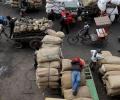
Growth in India is expected to slow to 6.3 per cent in FY 2023/24 (April-March), a 0.3 percentage point downward revision from January, the World Bank said Tuesday but noted there is an unexpected resilience in private consumption and investment and robust growth in the services. The World Bank made these points in its latest edition of Global Economic Prospects according to which global growth is projected to decelerate from 3.1 per cent in 2022 to 2.1 per cent in 2023. In Emerging Markets and Developing Economies (EMDEs) other than China, growth is set to slow to 2.9 per cent this year from 4.1 per cent last year. These forecasts reflect broad-based downgrades.

'Limited spillovers' to Asia's third-largest economy, even as world 'perilously close' to recession.

The World Bank has retained India's economic growth forecast for the current fiscal at 8.3 per cent as the recovery is yet to become broad-based. As per the first advanced estimates of the national income released by the National Statistical Office (NSO) last week, the economy is projected to grow at 9.2 per cent in 2021-22, surpassing pre-COVID level in actual terms, mainly on account of improved performance, especially in farm, mining and manufacturing sectors. "India's economy is expected to expand by 8.3 per cent in fiscal year 2021/22 (ending March 2022), unchanged from last June's forecast as the recovery is yet to become broad-based.
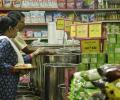
India's GDP growth to reach 8% by 2017. says World Bank

The World Bank also approved $200 million for Pakistan, $100 million for Afghanistan, $7.3 million for the Maldives and $128.6 million for Sri Lanka.

India's economy is estimated to contract by 9.6 per cent in the fiscal year 2020-21, reflecting a sharp drop in household spending and private investment, and the growth is expected to recover to 5.4 per cent in 2021, the World Bank said on Tuesday. In its Global Economic Prospects report, the World Bank said that the informal sector, which accounts for four-fifths of employment, has been subject to severe income losses during the COVID-19 pandemic.

Nepal's Prime Minister Sher Bahadur Deuba on Monday inaugurated the country's second international airport built by China that will help connect Lumbini, the birthplace of Lord Buddha and a major tourist and pilgrimage destination, to Buddhist circuits in South Asia as well as to the rest of the world.

Adopted after nearly two weeks of hectic negotiations, the first Global Stocktake deal, being termed the UAE consensus, urges countries to accelerate efforts toward the phase-down of unabated coal power, which is a climb down after India and China strongly resisted the singling out of coal.
India attracted a major chunk of the record $40.1 billion capital that flowed into South Asia in 2006, but restrictive policies could stunt investment growth leading to slower economic expansion, the World Bank warned in a report.

The pandemic has led to the International Finance Corporation massively ramping up its impact investment in the country - its largest client nation globally - at $1.7 billion as of June, a 51 per cent rise over the past 12 months, the largest developmental lender into third world private sector said on Tuesday. This is nearly half of its investment in the whole of South Asia since the pandemic, which touched $3.8 billion as of June 2021, it said. "Our total commitment to India, which is our largest client country globally, at the end of June stood at $1.7 billion representing an increase of over 51 per cent from last year," IFC vice-president for Asia and the Pacific region Alfonso Garcia Mora said in a statement.

The chief minister asked the delegation to consider new proposals under regional connectivity scheme and also to provide further assistance for newly notified state highways.

'For the common man, the economic conditions are not going to get better.'
This will be External Affairs Minister K Natwar Singh's first visit to Pakistan after assuming office.

Pakistan wanted to be constitutionally communal, India wanted to be secular but is communalising itself. All three nations share a penal code, but they have amended their laws to enable the State to specifically target minorities, points out Aakar Patel.

United States President Joe Biden will travel to India from September 7 to 10 to attend the G-20 Leaders' Summit during which he will discuss with other leaders a range of global challenges, including the Ukraine conflict, the White House announced on Tuesday.

ADB has often expressed its interest in promoting sub-regional integration in South Asia and perhaps could be involved as a facilitator.
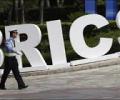
The opening ceremony was held in China's financial capital.
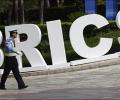
A feature of this year's BRICS summit was economic cooperation.

Severe heatwaves, responsible for thousands of deaths across India over the last few decades, are increasing with alarming frequency and soon the country could become one of the first places in the world to experience heatwaves that break the human survivability limit, according to a new report.

One thing is for sure: It smacks of the regulator's lack of confidence in the bank's board, points out Tamal Bandyopadhyay.

India's per capita GDP of $5,238 in 2013 was 65 per cent lower than Iran, 54 per cent lower than Maldives, 44 per cent lower than Sri Lanka and 27 per cent lower than Bhutan, according to the Human Development Report 2015

Modi knew in his heart that India does not have the financial muscle to support the new bank with offers of co-financing international projects, something China can do from the bank's base in Shanghai. If established in Mumbai, it may have employed a few Indian bankers and satisfied the national ego but there was little financial value to be drawn from it.
 © 2026 Rediff.com - Advertise with us - Disclaimer - Privacy Policy - Sitemap - Feedback - About us - Terms of use - Grievances